History Bites Book-Launch Event: an Academic & Culinary Success

A book & a cake

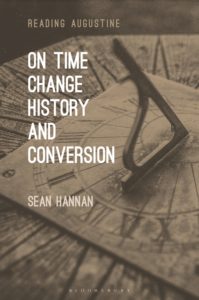
I am now in possession of a cake with an edible image of the cover of my own book on it. As part of the launch-event for my recent monograph On Time, Change, History, & Conversion (part of Bloomsbury’s Reading Augustine series), my colleague Dr. Aidan Forth surprised me with this astonishing culinary creation. The idea of cutting into & consuming my own intellectual output is a bit daunting, but I think I’ll give it a try this weekend.

We saw a fairly impressive turnout for our (aptly named) History Bites event on Google Meet, including scholars from Pennsylvania, Kentucky, Virginia, Illinois, & even the U.K. It was also cool to be joined by MacEwan folks from outside of the Humanities, from the Sociology Department and Student Affairs right on up to the Office of the President. Maybe this is one of the unexpected benefits of going virtual in the era of COVID: it means folks who otherwise might not have made it to a workshop in person can still engage remotely.

My thoughts now turn to anticipating our next History Bites book-launch, where I’ll be aiming to pay this “book-cake” business forward to one of my other colleagues in MacEwan’s Humanities Department.

E-Print of New Article: “The Camp of God”

My forthcoming article in the journal Political Theology, “The Camp of God: Reimagining Pilgrimage as Migrancy in Augustine’s City of God 1,” can now be viewed as an e-print (or electronic pre-print) on the Taylor & Francis website.

Check it out here:
https://www.tandfonline.com/doi/full/10.1080/1462317X.2020.1840036

This article represents the fruit of about four years of labour, since I first began workshopping these ideas back in 2016. After presenting the initial stages of my work at the annual meeting of the American Academy of Religion in November 2016, I turned to other projects, like my recent book on temporality & change in Augustine.

In 2019, I returned to my reinterpretation of Augustine in light of recent theories & theologies of migration. Thanks to some Twitter encouragement from James K.A. Smith, I redoubled my efforts, expanding my original attempt at retranslating Augustine to include a more sustained engagement with thinkers like Agamben, Thomas Nail, Ilsup Ahn, & Peter C. Phan.

In the future, I aim to build on this article by launching a lengthier project rooted in (what I see as) the still-fruitful connections to be drawn between a thoughtful reading of Augustinian peregrinatio & the figure of the migrant today. Given the ongoing plight of many migrant communities around the world, this strikes me as a topic more worthy of pursuit than ever before.

New Publication Piece for AJR

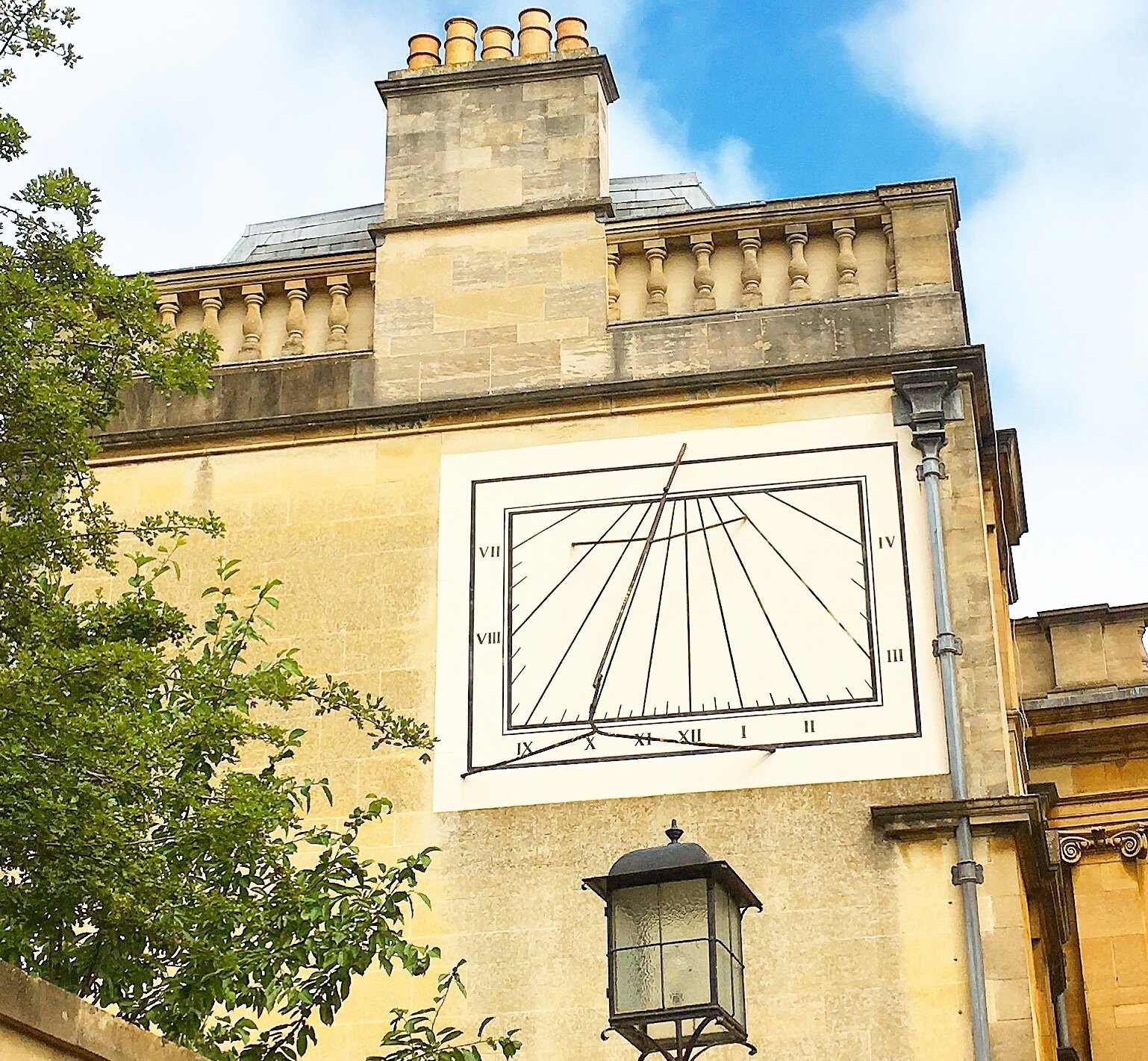
Sundial on Christ Church, Oxford, England (Image courtesy of the author).

I’ve written a new “publication piece” for AJR (Ancient Jew Review), a wonderful website & forward-thinking academic project run by a consortium of scholars & students of religion from around the globe. AJR is run by incredibly careful & competent folks, which meant that my piece was really tested by their keen editorial eyes. It was a privilege to have my writing receive that kind of diligent consideration.

The piece itself is partially an overview of my recently published book On Time, Change, History, & Conversion (still available from Bloomsbury itself, as well on Amazon). Part of the Reading Augustine series, edited by the intrepid Miles Hollingworth, the book aims to put Augustinian temporality into conversation with a wide range of different thinkers, both ancient & modern. That takes the reader from the Manichaean cosmographers of the fourth century to the Belgian priest-physicist Georges Lemaître in the twentieth, as well as from the Stoicism of Marcus Aurelius all the way up to the controversies of twenty-first-century psychology, including both Steven Pinker’s evolutionary overreach and the rise of the mindfulness movement.

My AJR article allows me to run through some of the major themes animating the book, while also pointing out some possible future connections between my own work & other burgeoning areas of research into the ancient Mediterranean world. I’d be especially excited to learn more about the relationship between cosmology & temporality in Syriac Christianity, for instance. Somehow, along the way, I’ve also managed to cram in here a reference to an Audi Spyder ad from years ago, just to keep things weird. Anyway, I suppose I just better let the piece speak for itself.

Article Published by Religion News Service


I was pleasantly surprised to learn that RNS (Religion News Service) has just picked up the article I’d originally written for the University of Chicago’s Sightings nearer to the beginning of this Coronatide season. In this piece, I tried to push back in a critical yet light-hearted way against some “hot takes” on how COVID-19 was radically transforming our experience of temporality. Those hot takes became something of a sub-genre in venues like the AtlanticNew Yorker for a few months earlier this year. You can check out the new & improved (because slightly edited) version of my article by clicking right here.

New Twitter Account for the American Cusanus Society

The American Cusanus Society now has a Twitter account! Check it out by clicking here. 

As Secretary, I’ll do my best to oversee the Twitter account in a way that does justice to the talents & achievements of the wide-ranging group of scholars making up our ACS membership.

At this point, my main goal is to build up a solid base of followers, so that we can keep folks informed not just about the state of Cusanus studies in general, but also about our exciting new series of lectures on beauty & truth in the Renaissance, hosted by the Lumen Christi Institute in Chicago.

Click here to learn more about that series of webinars (& please do register so that you can watch the webinars live!). 

Upcoming Book on Mysticism

I’m happy to report that W. Ezekiel Goggin & I have signed a contract to co-write a book on the modern reception of medieval mysticism for Routledge’s Contemporary Theological Explorations in Mysticism series.

The original title of the proposal was Exterminating Angels (based on a saying of the Romantic writer Jean Paul Richter), but we eventually arrived at something much more straightforward: Mysticism & Materialism in the Wake of German Idealism. While I don’t want to spoil too much here, the book should include chapters aiming to bring together the voices of Angela of Foligno, Meister Eckhart, Johann Tauler, Catherine of Siena, Kant, Fichte, Novalis, Hegel, Marx, & Bataille.

It should be a wild (but completely academically responsible) ride!

Article on Time & COVID Published in Sightings

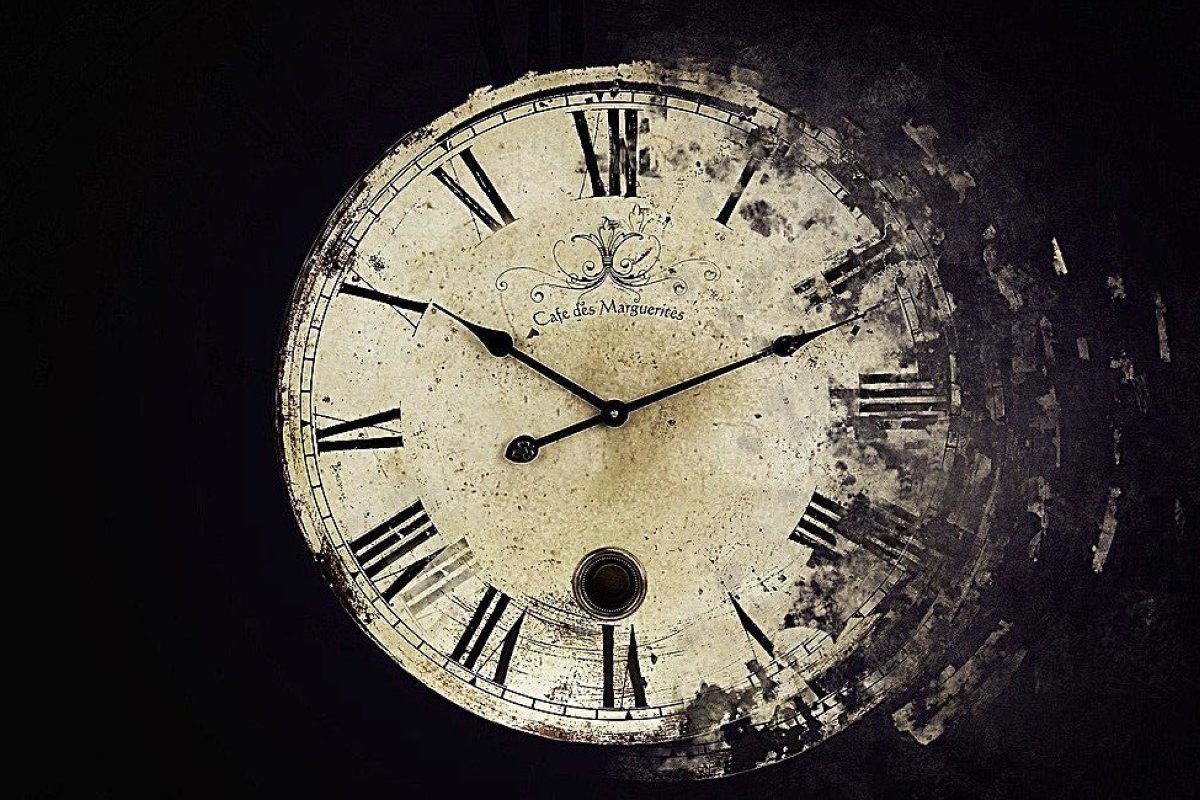
clock

Recently, I wrote an article for Sightings, a publication of the Divinity School at the University of Chicago. The piece, entitled “Time in Coronatide: Why We’re Not Actually Living in Groundhog Day,” takes its lead from a number of journalistic essays in venues like the Atlantic & the New Yorker, all of which speculate on how our experience of time might be altered by newly COVID-dictated schedules. By interrogating these essays alongside takes harvested from social media (mostly Twitter, where I first learned of the quasi-liturgical #Coronatide) and pop culture (e.g., The Last Dance documentary about Michael Jordan), I tried to push back against overly glib readings of our current situation, such as those likening it to old Bill Murray movies. The piece also aims to introduce some basic elements of the research that went into my recent book, especially when it comes to the differences between Augustine & the Stoics on the question of whether it makes any sense to “live in (or for) the present moment.”

Newly Named Secretary of the American Cusanus Society

I feel fortunate to be able to announce that for the next couple of years I’ll be serving as Interim Secretary for the American Cusanus Society. The Society is  devoted to the study of Nicholas of Cusa, his pathbreaking ideas, and the unique role he played within his own era (broadly situated at the intersection of the late Middle Ages & the humanist Renaissance). While members of the group come at Cusanus from a variety of angles, ranging from the history of mathematics to late medieval Christian-Muslim interactions, I’m most drawn to Nicholas’ contributions to the mystical tradition in works like De Docta Ignorantia, De Visione Dei, and De Non Aliud. If you’re interested in learning more about Nicholas of Cusa, check out the Society’s  website here.

Today is Book Release Day!

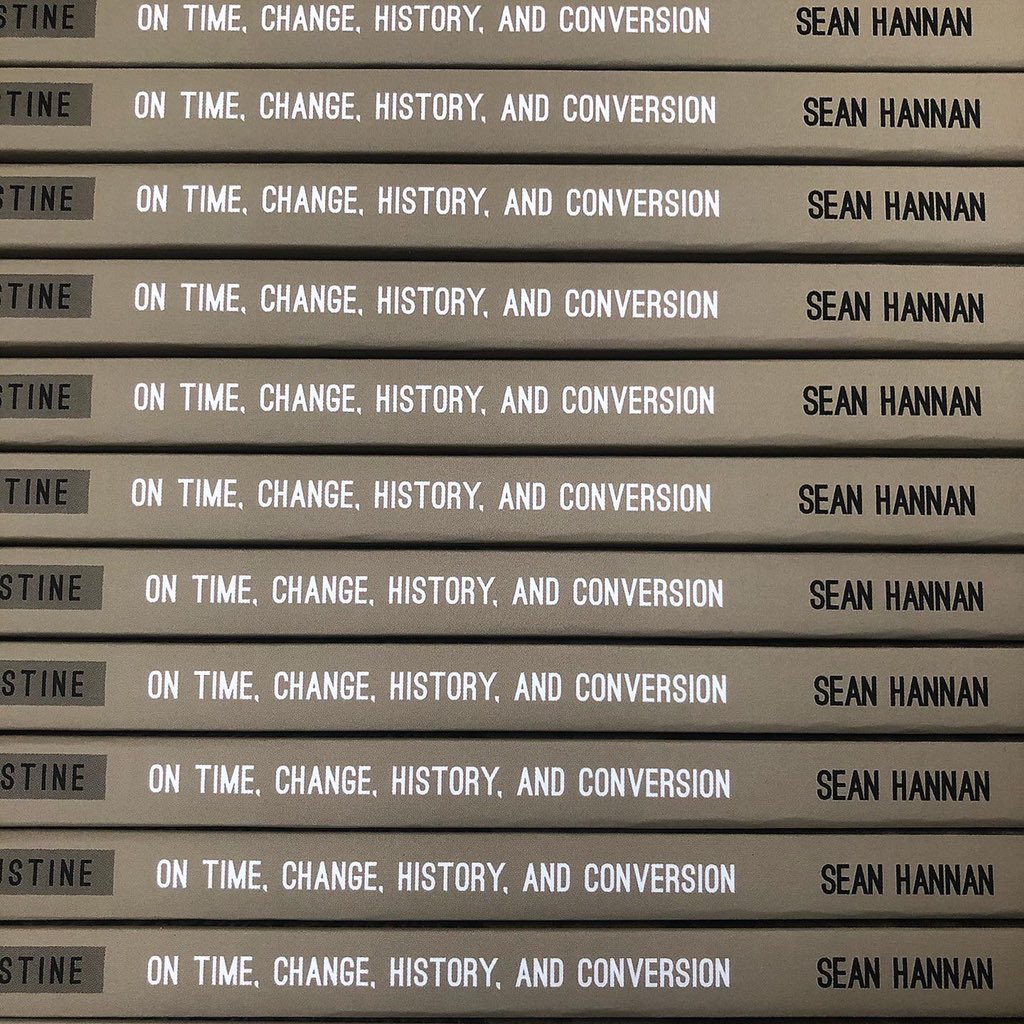
My book for Bloomsbury’s Reading Augustine series has officially been released as of today, April 16, 2020! Entitled On Time, Change, History, & Conversion, it can now be ordered in hardcover, paperback, or e-book formats. Here’s a link to the Bloomsbury site.

I’ll paste here the blurb from the Bloomsbury site, followed by the table of contents, just to offer a basic idea of what the book aims to accomplish:

Sean Hannan offers a new interpretation of Augustine of Hippo’s approach to temporality by contrasting it with contemporary accounts of time drawn from philosophy, political theology, and popular science. Hannan argues that, rather than offering us a deceptively simple roadmap forward, Augustine asks us to face up to the question of time itself before we take on tasks like transforming ourselves and our world.

Augustine discovered that the disorientation we feel in the face of change is a symptom of a deeper problem: namely, that we cannot truly comprehend time, even while it conditions every facet of our lives. This book puts Augustine into creative conversation with contemporary thinkers, from Pierre Hadot and Giorgio Agamben to Steven Pinker and Stephen Hawking, on questions such as the definition of time, the metaphysics of transformation, and the shape of history. The goal is to learn what Augustine can teach us about the nature of temporality and the possibility of change in this temporal world of ours.

Table of Contents

1. The Reality of Time: Between Idealism and Materialism
2. A Brief Theology of Time: From Creation to the Eschaton
3. Enlightenment Never: Eschatology Without Progress
4. Do Not Live in the Now: A Critique of Mindfulness
5. The Instant of Indecision: Possibility of Personal Change
6. The Time Is Not Now: Activism Despite Quietism
Conclusion: The Life’s Future

Reviews

“For Augustine of Hippo, time is a difficult and yet indispensable beloved. Sean Hannan deftly takes us into the soul-stretch that defines Augustine’s ambivalence toward time and complicates the finality of his final things. This book is witty, insightful, and relevant.”
–  James Wetzel, Villanova University, USA

“This is one of the most engaging and insightful recent books on Augustine of Hippo. Sean Hannan’s precise treatment unfolds the vast implications of Augustine’s understanding of time.”
–  Thomas Clemmons, Catholic University of America, USA

“Sean Hannan sketches Augustine of Hippo’s tensive view of time as indecisive yet activist, distended yet eschatological. This timely book makes a lasting contribution to one of the perennial problems in Augustine scholarship.”
–  Willemien Otten, University of Chicago, USA

Working at the juncture of historical and contemporary thought, Sean Hannan offers a provocative and insightful examination into the enduring philosophical and theological problem of human temporality. This book draws our attention to Augustine of Hippo’s enduring ability to illuminate a range of issues we continue to debate today.”
–  Matthew Drever, University of Tulsa, USA